Clean diagrams
Orthogonal wires that route around blocks, branching and junctions, named nets, one-step undo, and Arrange to tidy a drawing.
Gradara is a graphical workbench for electrical, mechanical, thermal, and control models. Wire a diagram, set parameters, and run it with the OpenModelica solver on your own computer.
Free · Windows, macOS, Linux · Apache-2.0 · Early release
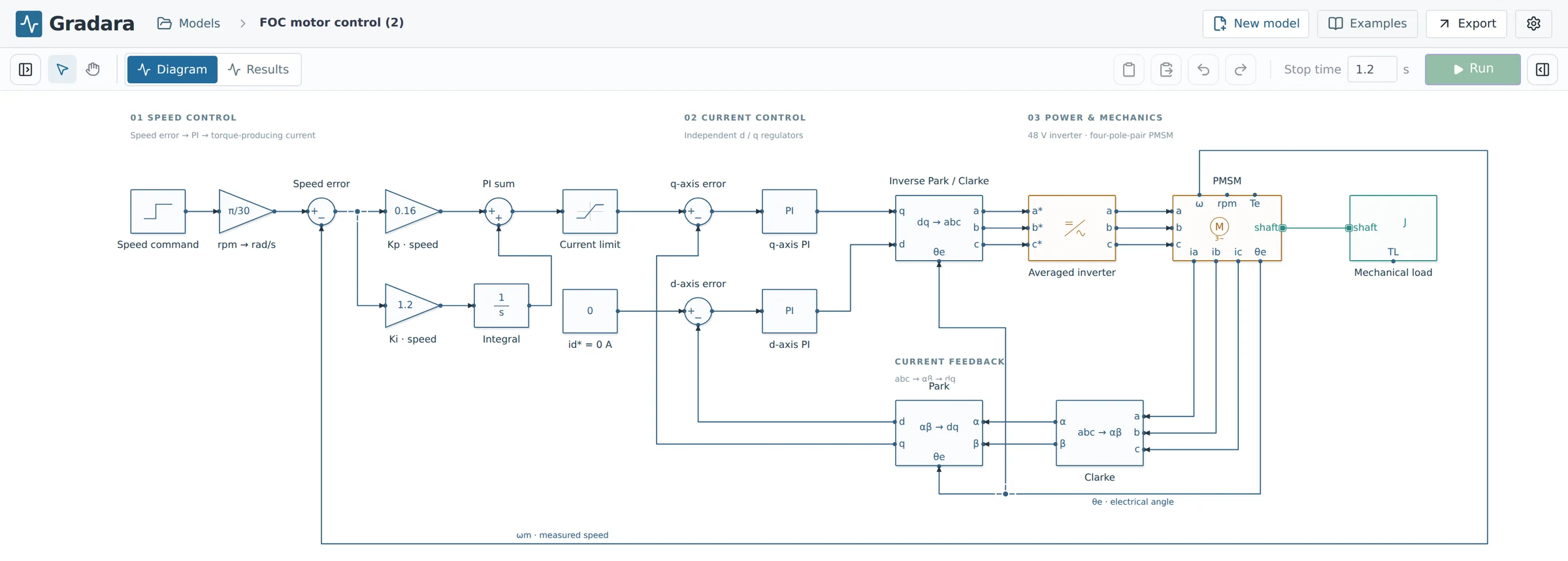
217 built-in blocks, most of them wrapping the Modelica Standard Library. Physical connections follow conservation laws, so a circuit behaves like a circuit and a shaft carries torque. Signals and physics meet through explicit sensors and actuators.
Sources, math, continuous and discrete blocks, nonlinearities, PI and PID, Clarke and Park transforms, and signal buses.
causal · realBoolean gates, comparators, hysteresis, flip-flops, edges, and timers for switching and protection logic.
causal · true/falseSources, passives, op-amps, diodes, thyristors and transistors, bridges, buck and boost converters, PWM, transformers, and DC, induction, and synchronous machines.
v · iThree-phase sources, R, L, and C loads, star and delta connections, a Dy transformer, inverters, and power sensors.
v · i per phaseInertias, springs, dampers, gears, loads, and speed and torque sensors coupled to machines.
φ · τMasses, springs, dampers, forces, and position sensors, down to a vehicle on a road.
s · fHeat capacitors, conduction, convection, and heat sources for losses and cooling.
T · Q̇Reluctances, windings, and magnetomotive sources for inductors and transformer cores.
V_m · ΦDirect manipulation stays fast, and the numerical work goes to a proven Modelica compiler and solver. Your models are plain files on your computer.
Orthogonal wires that route around blocks, branching and junctions, named nets, one-step undo, and Arrange to tidy a drawing.
Models compile to Modelica and run with the built-in OpenModelica 1.27 and the Modelica Standard Library 4.1.0, including events and stiff systems.
Plot any logged net or output, zoom into switching ripple, keep event pairs, and download the full CSV.
Group blocks into subsystems with typed ports, keep alternative designs behind one block, and switch whole configurations in one click. Worked examples from a DC motor to a three-level EV drivetrain.
Read and edit block equations, export Modelica source, and generate compile-checked C11 for a controller: a subsystem, selected signal blocks, or the one Gradara detects.
Everything runs on your computer. No account needed to model or simulate, and no analytics or tracking.
When the library does not have what you need, describe it. Gradara writes the equations, checks them with the compiler, and places a block you can inspect and edit. It can also build a complete first model from a description, propose checked edits to the model you have open, and explain why a run failed. Nothing changes until you review and apply it.
Choose signal, electrical, mechanical, thermal, or multidomain, and say what it should do.
The AI returns a structured definition with real ports and parameters, never free-form code.
Schema validation and the OpenModelica compiler run before anything reaches your diagram. One automatic repair if needed.
The block is saved in your model and your local library. Reuse and simulate it without calling AI again.
Illustrative request. Results depend on the description and the chosen block type.
Buy prepaid credits inside the app when you need them, or use your own AI account. No subscription and no card on file.
The complete workbench, forever.
Sign in and go. No keys or setup.
For regular use across projects.
Drawing, simulating, and exporting Modelica or C code for library blocks never use credits or an account. Only the AI features above do, and the app shows the price before you send.
Gradara is local first. Nothing leaves your computer unless you ask for an AI feature. Read the privacy notice.
Gradara AI processes requests in memory and does not store or log prompts, models, equations, or responses. Our AI provider, Anthropic, may keep requests briefly for abuse monitoring.
Only your email, credit balance, purchases, and per-request usage (task, model, token counts, time), with usage records deleted after about 13 months.
Your own API keys and your sign-in live in the operating system keychain and go only to their provider.
Delete your Gradara AI account from Settings. Your local models are never affected.
One download. The simulation engine, OpenModelica with the Modelica Standard Library, is included: nothing else to install.
Windows 10 or 11, 64-bit. Install and run your first model; the engine is built in.
Installer · x64Apple silicon or Intel, macOS 13 or newer. The engine runs in a small virtual machine built into the app. No Docker needed.
Disk image · .dmg64-bit Linux, .deb or AppImage. The engine is built in and compiles with your system's gcc.
AppImage · Debian and UbuntuStep-by-step instructions for each system are in the install guide. Prefer to build it yourself? Clone the repository and follow the setup guide. Release notes are on GitHub Releases.
Yes. The app is open source under Apache-2.0 and every modeling and simulation feature is free. Only the optional hosted AI uses paid credits, and you can use your own AI account instead.
No. Every installer includes the simulation engine. On macOS, where OpenModelica publishes no native builds, Gradara runs it in a small virtual machine that ships inside the app and uses Apple's built-in Virtualization framework. The virtual machine has no network access and only sees Gradara's data folder.
The physics comes from OpenModelica and the Modelica Standard Library. Automated tests compare Gradara's results with closed-form answers, from an RC circuit's time constant to a buck converter's ripple; the validation page lists them with measured values. Gradara is not certified for safety-critical use.
No. Gradara is an independent tool with its own model format and exports standard Modelica source. MATLAB and Simulink files are not supported.
Only when you use an AI feature, and only the context that request needs. Gradara AI does not store it; Anthropic, which runs the model, may keep it briefly for abuse monitoring. Simulation always runs locally.
Every block passes schema checks and the OpenModelica compiler before it appears, and its equations are visible and editable. Compiling is not the same as being physically correct, so review blocks the way you would review any model.
Gradara is developed by Virtu Services LLC, with contributions from the open-source community.
Open the DC motor or the buck converter, press Run, and explore the results.